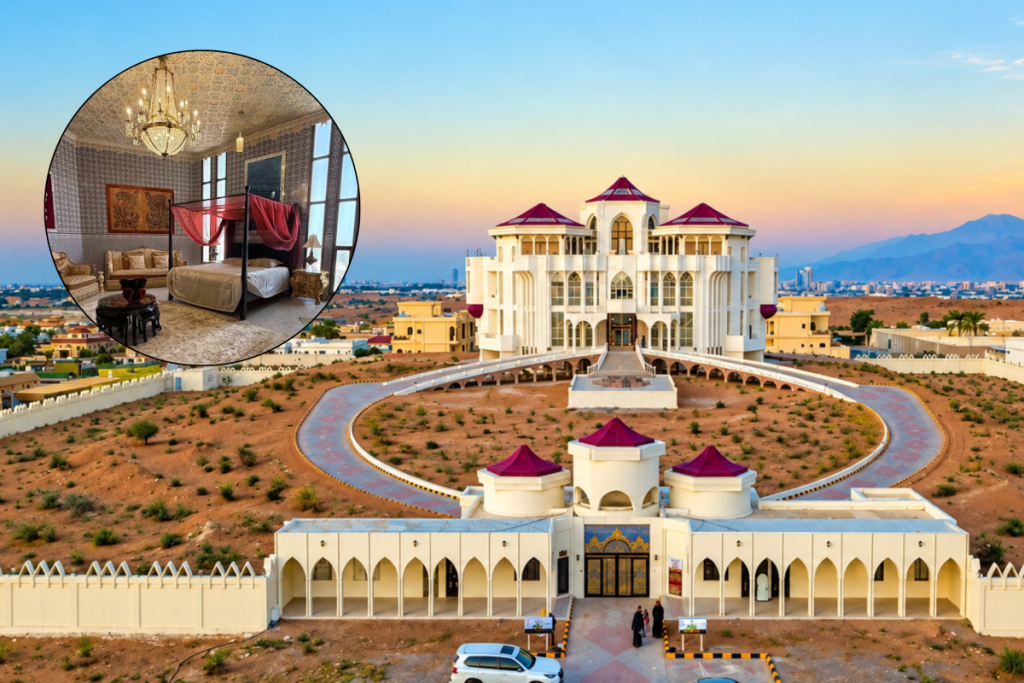

A four-story palace on a hill in Ras Al Khaimah, wrapped in decades of ghost stories, is looking for a new owner. Al Qassimi Palace, or the “Haunted Palace,” is listed at AED 22.5 million without furniture or AED 23.5 million with its original artefacts and collectibles. The listing carries one detail that matters for the building’s future: the ‘haunted palace’ has no heritage restrictions. The new buyer could demolish, rebuild, remodel, or renovate it. The owner, businessman and art collector Tareq Ahmed Al Sarhan, tried to sell it last October for AED 25 million.
Al Qassimi Palace is a beautiful hilltop destination, filled with legends
Sheikh Abdulaziz bin Humaid Al Qasimi, a member of Ras Al Khaimah’s ruling family and a patron of the arts, commissioned the palace in the 1970s. It was completed in 1991 at an estimated cost of more than AED 500 million. (Some listing details give a 1985 build date.) It sits on a 180,000-square-foot plot and has 34,000 square feet of built-up area.
Artisans from Iran, Morocco, India, and China left their mark in mosaics, painted tiles, frescoes, and walls painted with ghazals and birds. French and Belgian crystal chandeliers hang from the ceilings, and sculpted plaster pigeons and owls emerge from the walls. Inside are 35 bedrooms with balconies and terraces, a prayer hall, an office, and long hallways lit by arched windows that run from wall to ceiling.
Outside, an eight-pointed, star-shaped fountain marks the path across the sparsely landscaped grounds, followed by a bronze Saluki statue. Beyond it, the palace glows white with Thassos marble under burgundy pyramidal roofs.
The story behind the Haunted Palace
Sheikh Abdulaziz and his family may never have lived there.
One version says he stayed a single night before strange incidents drove the family away. Another says the family objected to the artworks, and the palace has stood empty for almost 35 years.
A former watchman reportedly heard children laughing and crying, and others spoke of faces, particularly children’s, appearing at the windows. Other stories describe jinns scratching the eyes out of painted figures, and religious figures being invited to drive them away. Others report flickering lights and weird sightings in the windows at night.
A second life as a museum
In 2019, the Sheikh’s heirs sold the palace to Al Sarhan. Over six months, restorers repaired its tiles, paintings, furniture, and sculptures. He renamed it Qasr Al Ghamedh, “The Palace of Ambiguity,” and opened it to the public as a museum and tourist attraction.
Whoever buys it will decide what comes next. Its architecture, design, and artistic merit reflect a particular moment in the emirate’s history. The palace never served as the family home it was built to be. But its beauty, abandonment, and mysteries have made it part of the country’s collective imagination.